


United Future Policy: Tax |

United Future will:
- Make the first $3000 of earned income tax-free, as part of the Working For Families package.
- Increase the other tax thresholds by $5000 to offset the increase in inflation (i.e. the 33% rate will apply to income over $43,000 rather than $38,000, and the 39% rate will apply to income over $65,000 rather than $60,000).
- Further lower tax rates, as economic conditions allow, with the goal of establishing a tax rate that is comparatively flat.
- Ensure that the taxation system takes into account the costs of raising a family by introducing income splitting for couples raising children.
- Reduce company tax to 30 cents in the dollar over the next three years
- Increase the tax rebate on donations from individuals to charitable organisations from $630 p.a. to $6,300 p.a. as a first step, with a comparable increase for companies
- Extend dividend imputation credits to registered charities upon the establishment of the Charities Commission
- Give working families the opportunity to receive their Working For Families entitlements in ways that do not resemble a benefit payment. United Future would explore the following alternatives for the delivery of family assistance:
- As a lump sum at the end of the tax year, to remove the possibility of overpayment and indebtedness to IRD, enabling families to use it to offset other tax liabilities (e.g. student loans).
- As a child tax allowance (reducing a family's taxable income by a certain amount per child) rather than a child tax credit (reducing a family's tax liability). This would be less likely to generate high effective marginal tax rates.
- As an adjustment to the take-home pay of parents, paid through the employer (as it is in the US and the UK).
- To be paid directly to the main carer, to reflect the value of their work.
- To be diverted into a workplace savings scheme, to help save for a house deposit
- To be diverted into a tertiary savings scheme.
- To be capitalised in advance and used to increase equity in a home.
- Recognise the impact of student loan debt on raising a family by freezing interest and writing off a portion of the debt of parents for two years after the birth of a child.
- Streamline the tax compliance and penalties regime
- Zero-rate local body rates for GST.
- Review the tax treatment of Research and Development, to generate incentives for an increase in private sector expenditure to 1.5% of GDP.
- Ensure that a significant proportion of fuel taxes collected within a specific region are earmarked for improvements to roads in that region, rather than being diverted into the Crown Account.
- Ensure that tax revenues collected from products as tobacco and alcohol are directly channelled into the health budget to recover the costs associated with their use.
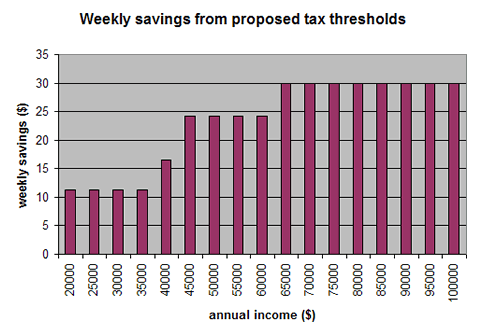
Comparing tax paid under the current system with United Future's proposed new tax thresholds
| Income | Current tax paid | Tax paid under new thresholds |
Savings per year |
Savings per week |
|---|---|---|---|---|
| $20000 | $3900 | $3315 | $585 | $11.25 |
| $25000 | $4875 | $4290 | $585 | $11.25 |
| $30000 | $5850 | $5265 | $585 | $11.25 |
| $35000 | $6825 | $6250 | $585 | $11.25 |
| $40000 | $8070 | $7215 | $855 | $16.44 |
| $45000 | $9720 | $8460 | $1260 | $24.23 |
| $50000 | $11370 | $10110 | $1260 | $24.23 |
| $55000 | $13020 | $11760 | $1260 | $24.23 |
| $60000 | $14670 | $13410 | $1260 | $24.23 |
| $65000 | $16620 | $15060 | $1560 | $30 |
| $70000 | $18570 | $17010 | $1560 | $30 |
| $75000 | $20520 | $18960 | $1560 | $30 |
| $80000 | $22470 | $20910 | $1560 | $30 |
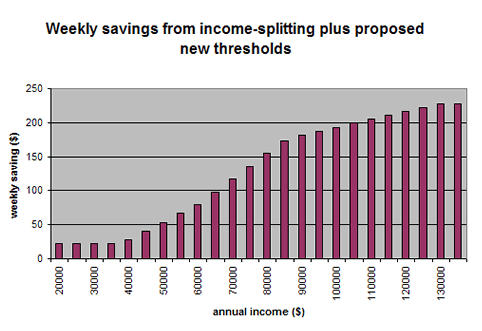
Comparing tax paid by a single income family under the current system with United Future's proposal for income splitting and new tax thresholds.
| Income | Current tax paid | Tax paid under income splitting |
Savings per year | Savings per week |
|---|---|---|---|---|
| $30000 | $5850 | $4680 | $1170 | $22.50 |
| $35000 | $6825 | $5655 | $1170 | $22.50 |
| $40000 | $8070 | $6630 | $1440 | $27.69 |
| $45000 | $9720 | $7605 | $2115 | $40.67 |
| $50000 | $11370 | $8580 | $2790 | $53.65 |
| $55000 | $13020 | $9555 | $3465 | $66.63 |
| $60000 | $14670 | $10530 | $4140 | $79.62 |
| $65000 | $16620 | $11505 | $5115 | $98.37 |
| $70000 | $18570 | $12480 | $6090 | $117.12 |
| $75000 | $20520 | $13455 | $7065 | $135.87 |
| $80000 | $22470 | $14430 | $8040 | $154.62 |
| $85000 | $24420 | $15405 | $9015 | $173.37 |
| $90000 | $26370 | $16920 | $9450 | $181.73 |
| $95000 | $28320 | $18570 | $9750 | $187.50 |
| $100000 | $30270 | $20220 | $10050 | $193.27 |
| $105000 | $32220 | $21870 | $10350 | $199.04 |
| $110000 | $34170 | $23520 | $10650 | $204.81 |
| $115000 | $36120 | $25170 | $10950 | $210.58 |
| $120000 | $38070 | $26820 | $11250 | $216.35 |
| $125000 | $40020 | $28470 | $11550 | $222.12 |
| $130000 | $41970 | $30120 | $11850 | $227.88 |
| $135000 | $43920 | $32070 | $11850 | $227.88 |
 |
|
||||||
|
|
Return to Policies Index | |
||||
|
|
||||||
Home | News | Successes | The Team | Policies | Get Involved
United Future Contacts: 0800 UFNZHQ
Parliamentary: Bowen House, Lambton Quay, Wellington E-mail: Ph: 04 471 9410